
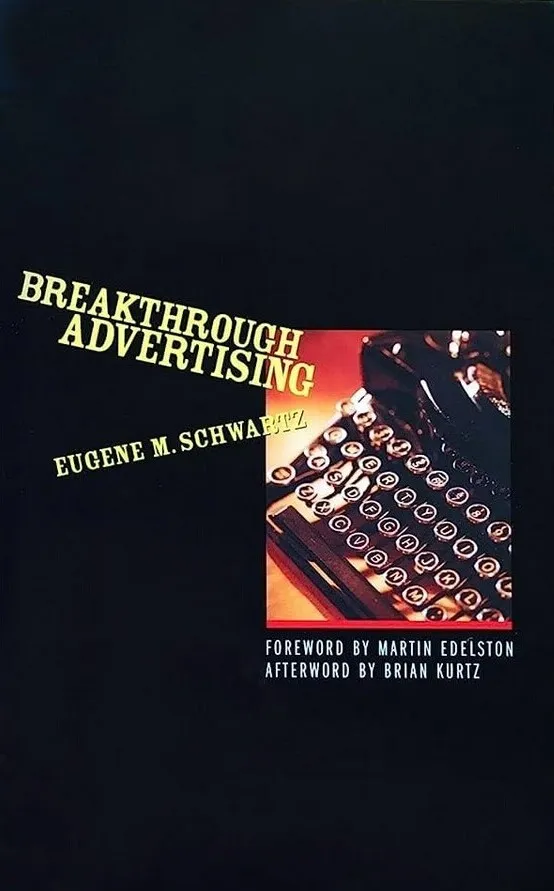
1. You cannot create desire. You can only channel existing desire.
-
The market already wants something: more money, beauty, status, security, freedom, convenience, recognition, belonging, etc.
-
Your job is not to convince people to want something they don’t want.
-
Find the strongest existing desire and connect your product to it.
-
Strong advertising therefore starts with market research, not copywriting.
-
Ask:
What does this market already desperately want?
Then:
How can my product become the vehicle for getting it?
This is arguably the central idea of the entire book. Schwartz describes advertising as directing existing mass desire toward a product.
2. Sell the functional product, not the physical product.
Every product is effectively two products:
- Physical product: what it is.
- Functional product: what it does for the customer.
People primarily pay for the second.
Don’t sell:
AI video generation software.
Sell:
Produce 20 ad concepts this afternoon without hiring a production crew.
Features matter mainly because they help prove that the promised result is possible.
3. Find one dominant mass desire.
Don’t try to sell ten desires simultaneously.
Find the desire that is:
- strongest,
- shared by enough people,
- urgent enough,
- and most naturally connected to your product.
Then make that desire the center of the campaign.
A product may have 30 benefits, but one usually has much more emotional force than the others.
One ad → one dominant desire.
4. Awareness determines where your ad should begin.
One of Schwartz’s most important frameworks is the 5 Stages of Awareness.
1. Completely Unaware
They don’t recognize the problem yet.
Don’t immediately pitch the product.
Start with:
- an experience,
- observation,
- story,
- identity,
- curiosity,
- surprising fact,
- recognizable situation.
You have the longest distance to travel.
2. Problem Aware
They know something is wrong but don’t know the solution.
Lead with the problem/desire.
Example:
You’re generating dozens of AI videos, but only two are usable.
Then gradually introduce the solution.
3. Solution Aware
They know solutions exist but don’t know your product.
Lead with:
- your approach,
- new solution,
- mechanism,
- better way of achieving the result.
Example:
Instead of generating complete AI videos repeatedly, perfect the composition as an image first.
4. Product Aware
They know your product but aren’t convinced.
Focus on:
- why yours is different,
- strongest benefit,
- proof,
- mechanism,
- testimonials,
- comparison,
- objections.
5. Most Aware
They already know the product and want it.
Don’t educate them unnecessarily.
Lead with:
- offer,
- price,
- bonus,
- new version,
- availability,
- deadline,
- reason to act.
Rule:
The less aware the prospect is, the more indirect your opening usually needs to be.
The more aware the prospect is, the more directly you can sell.
5. Don’t write one ad for every awareness level.
This is a huge practical lesson.
The same product may need completely different ads.
For example:
Unaware:
Why do some AI ads instantly look “AI-generated”?
Problem aware:
Your AI video isn’t expensive because the model costs too much. It’s expensive because you’re generating too many unusable takes.
Solution aware:
Generate the image first. Animate it second.
Product aware:
Why creators use Kie instead of buying credits from every AI model separately.
Most aware:
Get $20 of Kie credits today.
Same product.
Completely different entry points.
Market Sophistication
6. Awareness and sophistication are NOT the same thing.
Awareness asks:
How much does this person know?
Sophistication asks:
How many similar marketing promises has this market already heard?
This distinction is extremely important.
A prospect can be problem-aware while participating in an extremely sophisticated market.
7. Stage 1 Sophistication: State the benefit.
When the market is new, simple claims can work.
Generate videos using AI.
There is little need for elaborate differentiation because the result itself is novel.
8. Stage 2: Make the promise bigger.
Competitors appear.
Everyone is making the basic promise.
The natural next move is:
- faster,
- easier,
- bigger,
- stronger,
- cheaper,
- more complete.
Instead of:
Generate AI videos.
You might get:
Generate professional AI videos in minutes.
9. Stage 3: Stop enlarging the promise. Introduce a new mechanism.
Eventually people stop believing increasingly exaggerated promises.
Now the question becomes:
WHY does this work?
Instead of making the benefit bigger, introduce a different mechanism for achieving it.
Old:
Lose weight quickly.
Mechanism-driven:
A new process targets X, which causes Y.
In modern marketing:
Create better ads.
becomes:
Our AI analyzes the first three seconds of winning ads and rebuilds your hook around the same attention patterns.
The mechanism makes an old desire feel new again.
10. Stage 4: Make the mechanism better.
Eventually competitors start copying mechanisms too.
Now differentiate the mechanism itself.
Your mechanism becomes:
- faster,
- more precise,
- easier,
- proprietary,
- more complete,
- more advanced,
- more reliable.
Example:
Generic:
AI analyzes your ads.
Stage 4:
Our frame-level model analyzes 47 visual and behavioral signals during the first three seconds of every ad.
You’re no longer merely selling the result.
You’re selling why your way of producing the result is superior.
11. Stage 5: Move toward identity.
Eventually the audience has heard:
- every promise,
- every mechanism,
- every “revolutionary breakthrough.”
Claims lose novelty.
One remaining path is identification.
Instead of:
Our camera takes better pictures.
The advertising becomes:
This is the camera serious photographers use.
Now the product says something about who the customer is.
Headlines
12. The headline doesn’t need to sell the product.
Its first responsibility is getting the right prospect into the copy.
Think:
Headline → next sentence → next sentence → next sentence → sale.
Trying to make the headline perform the entire sale often weakens it.
The headline should connect the prospect’s current mental state with the next piece of information they want to know.
13. Decide WHAT to say before deciding HOW to say it.
This distinction is extremely important.
First determine:
- mass desire,
- awareness,
- sophistication,
- promise,
- mechanism,
- angle.
Only then worry about:
- clever wording,
- rhythm,
- phrasing,
- hooks,
- headline formulas.
Strategy comes before verbalization.
14. Don’t blindly copy headline formulas.
Schwartz distinguishes genuine creative strategy from simply replacing words in successful headlines.
A formula can help organize an idea.
It cannot tell you which idea the market needs to hear.
A better process:
Market → Desire → Awareness → Sophistication → Angle → Headline
not:
Headline template → Product
Body Copy
Schwartz essentially describes persuasion as working through three forces:
DESIRE + IDENTIFICATION + BELIEF → CONVICTION
Your copy has to increase one or more of these.
15. Intensification: don’t repeat the benefit. Expand it.
One of the book’s most useful lessons.
Suppose your benefit is:
Save 10 hours every week.
Bad copy repeats it:
Save time. Work faster. Spend fewer hours working. Become more efficient.
These are basically the same statement.
Instead, walk around the benefit.
Show what those ten hours mean:
- leave work at 4 instead of 7,
- launch another campaign,
- spend Friday afternoon with your family,
- take another client,
- stop working Sundays,
- wake up without unfinished tasks hanging over you.
Same desire.
Different pictures.
That’s reinforcement without repetition.
16. Make benefits visual and experiential.
Don’t merely say:
Easier workflow.
Show the experience:
Upload the product shot, choose a model, and have three usable variations ready before your coffee gets cold.
The prospect should mentally experience ownership before purchasing.
17. Put the product in action.
Instead of simply describing what something can do, demonstrate the sequence.
Weak:
Automatically creates ad variants.
Stronger:
Upload one winning ad. It extracts the hook, visual structure and CTA, then turns them into ten new concepts.
Action feels more believable than adjectives.
18. Put the reader inside the demonstration.
Don’t only show the product operating.
Show the prospect using it.
Move from:
It produces five variations.
to:
You open your dashboard Monday morning and five new variations are already ready to test.
The benefit becomes personal.
19. Extend the benefit through time.
Show:
- first use,
- first week,
- first month,
- long-term result.
The product becomes a change in the customer’s life rather than a momentary feature.
20. Show the negative side of the desire.
Desire has two sides:
What I want.
and
What I want to escape.
If someone wants cheaper AI production, you can show:
Positive:
Produce twice as many creatives with the same budget.
Negative:
Stop burning $50 generating clips you’ll never use.
Both intensify the same fundamental desire.
Identification
21. People buy things partly because of what those things say about them.
Products can represent:
- intelligence,
- taste,
- sophistication,
- rebellion,
- professionalism,
- wealth,
- creativity,
- membership,
- expertise.
Ask:
Who does my customer want to feel like?
Then:
Can ownership/use of my product reinforce that identity?
22. Give the product a personality.
A product can feel:
- expert,
- rebellious,
- premium,
- minimal,
- technical,
- artistic,
- elite,
- accessible,
- professional,
- underground.
That personality attracts people who want to identify with those qualities.
Branding therefore isn’t decoration.
It can become part of the selling mechanism itself.
Belief
23. Desire without belief doesn’t produce the sale.
Your customer may desperately want the result and still think:
Sounds good, but I don’t believe you.
Therefore copy has two separate jobs:
Increase desire.
and
Make the promise believable.
The stronger the claim, the more belief-building you usually need.
24. Gradualization: never ask the prospect to make one giant leap of belief.
This is one of the most underused ideas in the book.
If the final claim sounds unbelievable, don’t immediately state it and pile proof underneath it.
Create a chain:
Something they already believe
↓
Something logically connected
↓
Something slightly new
↓
Another logical conclusion
↓
Your major claim
Each statement prepares the prospect to accept the next.
25. Start from the prospect’s existing reality.
Don’t begin by telling customers that everything they believe is wrong.
Begin with facts or experiences they already accept.
Then move them toward your interpretation.
For example:
AI video generation is becoming cheaper.
Easy to accept.
↓
But generation price isn’t the only cost.
Also reasonable.
↓
Failed generations can represent most of your actual production cost.
Now we’re introducing a new perspective.
↓
So the cheapest model may actually produce the most expensive usable video.
The reader arrives at a conclusion that would have sounded strange if stated immediately.
Redefinition
26. Don’t always fight an objection. Change the frame.
Schwartz calls this Redefinition.
The customer says:
It’s expensive.
Instead of arguing:
No, it isn’t.
Change what they compare it against.
Instead of:
$500 software.
Frame it as:
Less than the cost of one professionally produced video.
Same price.
Different frame.
27. A weakness can sometimes become proof of a strength.
What initially looks like a disadvantage can sometimes be reinterpreted as the consequence of something valuable.
Examples:
Takes longer → handmade.
More expensive → higher-quality inputs.
Smaller company → personal support.
Limited availability → quality control.
But the reframe must be truthful and causally believable.
Mechanization
28. When people ask “How can this possibly work?” give them a mechanism.
Mechanization provides the reason why.
The mechanism explains how the promise is produced.
You can:
- Name the mechanism
- Describe the mechanism
- Feature the mechanism as a central part of the sale
The more skeptical or sophisticated the market, the more important mechanism often becomes.
29. Mechanisms make familiar promises feel fresh.
Customers have already heard:
Improve your ROAS.
But maybe they haven’t heard:
Creative Fatigue Prediction.
The desire isn’t new.
The explanation of how you achieve it is new.
This lets you revive an old promise without simply making it more exaggerated.
30. Specific explanations often act as proof.
Compare:
Our AI produces better ads.
with:
We analyze the first 3 seconds separately because that’s where the majority of scroll/no-scroll decisions happen.
The second statement gives the brain something concrete to understand.
Mechanism reduces the feeling of:
“Just trust us.”
Concentration
31. You’re not only competing against competing products.
You’re competing against every alternative way of satisfying the desire.
If you sell AI ad generation, alternatives include:
- agencies,
- freelancers,
- internal designers,
- filming manually,
- other AI tools,
- doing nothing.
Your copy should make your chosen path feel increasingly logical relative to those alternatives.
32. Don’t automatically attack competitors directly.
Often the stronger strategy is to redefine the buying criteria.
Rather than:
Competitor X is worse.
Create a criterion where your product naturally wins.
Example:
Everyone compares AI tools by:
cost per generation.
You introduce:
cost per usable clip.
Suddenly the entire comparison changes.
This is an extremely powerful strategy.
Camouflage
33. When advertising itself causes skepticism, make the message feel like the surrounding medium.
Schwartz calls this Camouflage.
The concept isn’t hiding that something is advertising.
It’s reducing the resistance people have to stereotypical “ad language.”
Examples today:
- UGC-style videos,
- founder videos,
- educational Reels,
- demonstrations,
- advertorials,
- tutorials,
- interviews,
- native-looking posts.
The sales message is delivered through a format the audience is already comfortable consuming.
34. Match the language of the environment.
An Instagram Reel shouldn’t sound like a corporate brochure.
A Reddit-style ad shouldn’t sound like a television commercial.
A technical landing page shouldn’t sound like a TikTok influencer.
The more naturally the message fits the audience’s existing communication environment, the less unnecessary resistance it creates.
Proof
35. Don’t dump proof randomly. Place it where skepticism appears.
Proof works best when it answers a question already forming in the reader’s mind.
Promise:
Generate ads 5× faster.
Reader thinks:
Really?
Now proof.
Mechanism:
Here’s how.
Reader thinks:
Does that actually work?
Now demonstration/testimonial/data.
Think of copy as a conversation with objections happening silently inside the customer’s head.
36. Anticipate the next question.
After every section, ask:
What is the reader thinking right now?
Typical progression:
Interesting.
→ How?
→ Really?
→ Will it work for me?
→ Is it difficult?
→ What’s the catch?
→ How much?
→ Why now?
Great copy answers these questions at approximately the moment they appear.
Structure
37. Copy should have momentum.
Every section should create a reason to consume the next.
Headline →
first line →
demonstration →
mechanism →
benefit →
proof →
objection →
offer.
Don’t treat copy as independent blocks.
Treat it as a controlled sequence of mental reactions.
38. There is no universal “correct” copy length.
The right length is:
however long it takes to create sufficient desire, identification and belief.
A retargeting ad aimed at Most Aware buyers may require five words.
An unfamiliar product aimed at cold prospects may need several minutes of explanation.
Don’t ask:
Is this copy too long?
Ask:
Is every part still doing persuasive work?
39. Long copy should deepen, not repeat.
Every new section should contribute something new:
- new benefit,
- new scene,
- new mechanism,
- new proof,
- new identity,
- new objection answered,
- new implication.
If paragraph 8 merely restates paragraph 3, delete it.
Creative Strategy
40. The copywriter’s highest-value work happens before writing.
The most important decisions are:
- Which market?
- Which mass desire?
- Which segment?
- Which awareness level?
- Which sophistication stage?
- Which product performance connects to that desire?
- Which mechanism makes the promise believable?
- Which angle presents it freshly?
The actual wording comes afterward.
41. Don’t invent cleverness. Discover the angle.
The strongest advertising ideas usually come from understanding:
- the product,
- the market,
- competitors,
- customer language,
- current beliefs,
- frustrations,
- failed alternatives.
Your job isn’t:
“Come up with something clever.”
It’s:
“Discover the most powerful relationship between this product and this market.”
42. Your competitor’s successful ads teach you what the market already believes.
Study competitor advertising to discover:
- promises customers already respond to,
- mechanisms they’ve already heard,
- claims that have become clichés,
- sophistication level,
- objections,
- category language.
Competitor research isn’t primarily for copying.
It’s for understanding what the market has already been told.
43. The best new angle often comes from changing the explanation, not changing the desire.
People’s fundamental desires don’t change very quickly.
What changes is:
what they believe will satisfy those desires.
Therefore innovation in advertising often means:
Old desire + New mechanism
or:
Old desire + New interpretation
or:
Old desire + New identity
rather than inventing a completely new desire.
The Final Copy Principles
44. Verification
Support important claims with:
- demonstrations,
- data,
- testimonials,
- authorities,
- evidence,
- guarantees,
- specifics.
But introduce proof when the reader needs proof.
45. Reinforcement
Two ideas can strengthen each other when deliberately placed together.
Example:
More expensive because every piece is handmade.
Price objection + craftsmanship proof become mutually reinforcing.
46. Interweaving
The strongest sentences can perform several functions simultaneously.
A sentence can communicate:
- benefit,
- mechanism,
- proof,
- imagery,
- emotion.
Instead of writing separate blocks for each, weave them together naturally.
47. Sensitivity
Continuously anticipate changes in the prospect’s mental state.
When curiosity becomes skepticism → give proof.
When proof becomes technical → return to benefit.
When desire is high but risk appears → introduce guarantee.
Copy isn’t simply information.
It’s reaction management.
48. Mood matters.
The emotional atmosphere of the copy affects how claims are interpreted.
The same factual argument can feel:
- exciting,
- serious,
- exclusive,
- rebellious,
- comforting,
- authoritative.
Word choice and rhythm create this atmosphere.
The Schwartz Advertising Process
Before making an ad, answer these questions in this order:
- Who exactly am I selling to?
- What do they already desperately want?
- Which single desire am I going to target?
- What do they already know about the problem?
- What do they know about possible solutions?
- What do they know about my product?
- What claims have competitors already made to them?
- How sophisticated is this market?
- What promise can I legitimately make?
- What mechanism explains why that promise is possible?
- What makes my mechanism/product different?
- What existing beliefs can I start from?
- What must they believe before they can buy?
- What chain of beliefs gets them there?
- What objections will appear along the way?
- How can I redefine those objections?
- What proof belongs at each point?
- What identity does the customer want to associate with?
- What alternatives am I competing against?
- What should the headline say to make this exact prospect continue?
Only after answering these should you start worrying about the wording.
The Most Important Lessons in One Page
If I had to reduce the entire framework to only 10 rules, I would keep these:
-
Don’t create desire — find existing desire and channel it.
-
Sell what the product does for the customer, not what the product is.
-
Match your message to the customer’s stage of awareness.
-
Match your claim to the market’s level of sophistication.
-
When bigger promises stop working, introduce a new mechanism.
-
Don’t repeat benefits — intensify desire by showing the benefit from new angles.
-
Build belief gradually instead of demanding that the customer accept a huge claim immediately.
-
Reframe objections instead of merely arguing against them.
-
Explain why the product works and strategically place proof where skepticism appears.
-
Do the strategic thinking before writing the copy: market, desire, awareness, sophistication and mechanism determine the ad far more than clever wording does.
The single biggest takeaway
Great advertising doesn’t begin with:
What should we say about our product?
It begins with:
What does this market already want, believe and know — and how can we connect that existing mental state to our product?
That shift—from product-first advertising to market-first advertising—is the foundation underlying almost everything Schwartz teaches.