
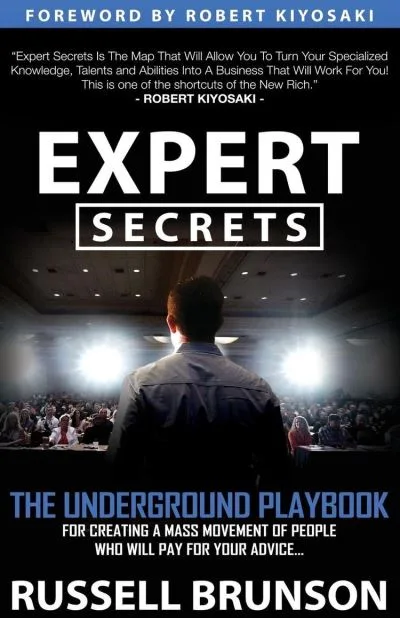
Brunson sells funnel software, and the book is a long demonstration of the thing it teaches. That is either the strongest argument for it or the reason to distrust it. Past the hype the mechanics hold up. It is a manual for turning what you know into an offer people buy, built on stories rather than arguments.
Build a movement, not an audience
- Three parts, all required: a leader people want to follow, a cause pointed at the future, and a new opportunity. Two out of three is a hobby.
- You don’t need to be the best in the world. You need to be one step ahead of the people you serve, and to have written down the walk.
- Pick a niche inside one of the three markets people already spend on: health, wealth, relationships. Narrow beats broad every time.
- Your backstory, your flaws and your unpopular opinions are the product. Characters with positions get followed. Neutral ones get scrolled past.
Sell a new opportunity, never an improvement
- The one big idea of the book. Improvement offers ask people to admit they failed and try harder. A new opportunity lets them start clean.
- Every buying decision is a status decision. “Get better at X” costs status. “Here is a different X” pays it.
- Switch the opportunity, don’t stack it. Move people onto a new vehicle instead of selling a faster version of the one that already let them down.
- Name the vehicle. An unnamed method is a commodity.
Knock over one domino
- Write the Big Domino statement. If they believe your new opportunity is the key to what they want, and that it’s only reachable through your vehicle, every other objection stops mattering.
- One belief, not five. Most presentations fail because they try to prove too much.
Teach with stories, not logic
- Tell the story of the moment you understood, so the audience gets the realization instead of your conclusions. Brunson calls it the Epiphany Bridge.
- The curse of knowledge is what ruins experts. You explain in jargon, they hear noise, and nobody thinks you’re smart.
- The script runs backstory, what you wanted, the wall you hit, the epiphany, the plan, the conflict, the result, the transformation.
- Every hero takes two journeys, an outer one about achievement and an inner one about who they became. People buy the inner one.
- People decide on emotion and justify with logic. The story carries the emotion. The logic is what they repeat to their partner that evening.
Break the three false beliefs
- Every prospect holds three objections: the vehicle doesn’t work, I couldn’t do it, something outside me will stop me.
- Each objection came from something they lived through. Only another story replaces it. Arguing loses.
- So the teaching is three secrets, one per false belief, each one an epiphany bridge with proof attached.
- Ask for small yeses the whole way through. Does that make sense? Who wants to see the next one? The big yes is easier after twenty small ones.
The offer and the ask
- Build the offer as a stack. Add one piece, restate the whole stack, add the next. Price comes last, against the total you just read out.
- Each element does one job and gets one sentence. If you can’t say what it removes, cut it.
- The Perfect Webinar sequence: hook and big domino, origin story, three secrets, stack, close. It works on a stage, a sales call, a VSL, an email series.
- Brunson frames hard selling as a moral obligation. I’d hold that at arm’s length, though if you genuinely believe your thing works it’s hard to argue with.
After the script
- Traffic is the rest of the job. Build the Dream 100, a list of the places your people already gather, then go and get them.
- Publish while you’re still learning. The archive is what makes you the leader later.